Customized Policy and Procedure Manuals
October 21, 2025
2026 Laboratory Budgets | Planning 5 Best Investments
December 16, 2025Navigating the Clinical Analyzer Market: What Every Laboratory Needs to Know
Making Smart Equipment Decisions in a Complex Marketplace
Selecting the right clinical chemistry analyzer can make or break a laboratory’s success. Whether you’re launching a new physician office lab, expanding your test menu, or upgrading aging equipment, the decisions you make today will impact your operations, compliance status, and bottom line for years to come.
The equipment market presents both opportunities and pitfalls. New analyzers offer cutting-edge technology but come with premium price tags. Used and refurbished systems can deliver 40-60% savings but require careful vetting to avoid costly mistakes. And when it’s time to sell surplus equipment, understanding market dynamics becomes essential to recovering value from your investment.
At Laboratory Management Consultants, we’ve guided hundreds of laboratories through these critical decisions. We don’t just advise on equipment selection, we actively buy and sell clinical analyzers, giving us real-world insight into what works, what doesn’t, and what you need to know before making a commitment.
This guide walks you through the key platforms laboratories depend on, the real considerations around buying and selling, and how to avoid the mistakes that turn equipment investments into expensive regrets.
Understanding Your Laboratory’s Real Equipment Needs
Before exploring specific platforms, it’s worth stepping back to assess what your laboratory actually needs. Too many labs make equipment decisions based on impressive specifications rather than operational reality.
Start with your test volume projections. A common mistake is buying equipment sized for current volume when you should be planning for 1.5x your projected growth over the next two years. Underestimating capacity leads to bottlenecks and rushed purchases down the road. Overestimating, however, means paying for throughput you’ll never use.
Consider your physical space and infrastructure. That high-performance analyzer might look perfect on paper, but if it requires dedicated water lines, drainage systems, or electrical upgrades your facility can’t accommodate, you’re facing thousands in unexpected renovation costs. Compact benchtop systems increasingly deliver impressive capabilities without the infrastructure headaches.
Think about your staffing reality. The most sophisticated analyzer in the world won’t help if your team lacks the training to operate it effectively. Moderate complexity systems offer the sweet spot for many physician office labs—robust capabilities without requiring PhD-level technical expertise.
Finally, align equipment decisions with your accreditation timeline. Purchasing new analyzers just weeks before a CLIA renewal or CAP inspection creates validation pressure and rushed implementation. Plan equipment acquisitions at least 3-6 months before major inspections to allow proper validation, staff training, and workflow integration.
Five Clinical Analyzer Platforms That Drive Laboratory Success
Laboratory Management Consultants specializes in five proven platforms that consistently deliver results for small to mid-sized laboratories. These aren’t the only analyzers on the market, but they represent the equipment we see performing reliably across diverse laboratory settings.
Medica EasyRA: Compact Power for Growing Labs
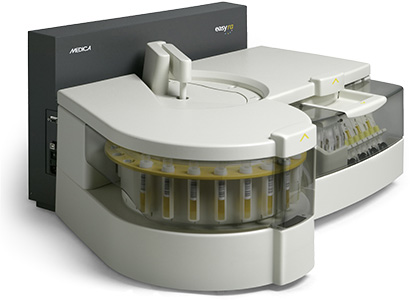
The EasyRA has earned its place in hundreds of small laboratories through genuine ease of use and reliable performance. This fully automated benchtop clinical chemistry analyzer delivers up to 300 photometric tests per hour (or 480 when integrated with the optional ISE module) making it ideal for physician office labs processing 50-200 daily tests.
What sets the EasyRA apart is its RFID-enabled “smart reagent” system. When you place a reagent wedge anywhere in the reagent area, the analyzer automatically identifies location, remaining samples, volumes, and expiration dates. This eliminates manual programming errors that can derail quality control and create documentation headaches during inspections.
The system’s unique slide-out drawer provides unprecedented access to all replaceable components. Maintenance becomes quick and straightforward, reducing service calls by up to 40% according to user reports. For STAT testing, the EasyRA delivers results in less than 8 minutes for critical tests like electrolytes and renal panels.
With 24 sample positions and 24 cooled reagent positions on board, the system handles routine chemistry workflows efficiently. The color-coded touchscreen interface means lab technicians become proficient with minimal training. That’s a crucial consideration when staff turnover is always a concern.
The EasyRA fits on standard laboratory benches and doesn’t require external water lines or dedicated drainage. For laboratories operating in leased medical office buildings or those looking to minimize renovation costs, this self-contained design can save thousands in facility modifications.
Thermo Fisher Indiko Plus: Versatile Mid-Volume Chemistry
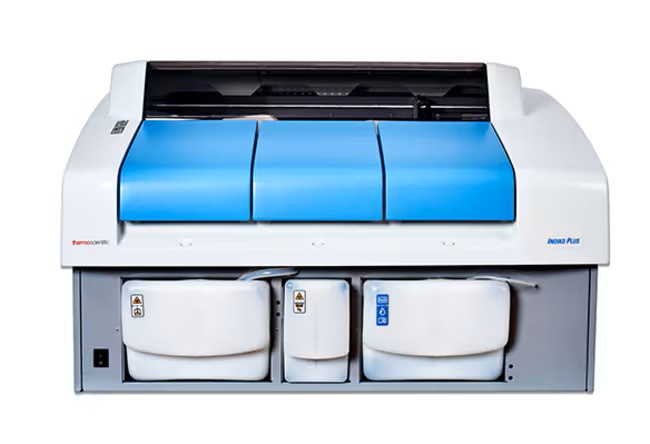
When laboratories need more throughput and flexibility, the Indiko Plus delivers. This fully automated random-access system handles up to 350 photometric tests per hour with room for up to 108 sample positions and 42 reagent positions on board.
The Indiko Plus excels at sample-oriented testing, generating results quickly to enhance patient care quality. Its application protocols cover routine clinical chemistry plus specialized testing including specific proteins, drugs-of-abuse, therapeutic drug monitoring, and immunosuppressant monitoring, making it particularly valuable for laboratories serving diverse patient populations.
Disposable cuvettes eliminate contamination concerns between different test types. Automated dilution features and reflex testing capabilities save operator time by automatically triggering specific follow-up tests based on initial results. Real-time quality control monitoring provides confidence in measurement reliability throughout the day.
The bidirectional LIS connection ensures seamless data flow and full traceability. Results archiving associated with calibration and reagent lot data provides the documentation surveyors expect to see during inspections.
At 94 cm wide by 70 cm deep by 62 cm high and weighing 110 kg, the Indiko Plus requires more space than compact benchtop systems but still fits comfortably in most laboratory settings. Water consumption of 2.5L per hour and power consumption of just 300 watts keep operating costs manageable.
For laboratories processing 200-500 tests daily across multiple test types, the Indiko Plus represents the versatile workhorse that can grow with your operation.
Abbott ImmTox 270: Specialized Toxicology Screening
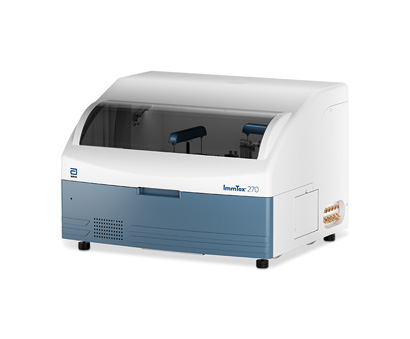
Pain management clinics, addiction treatment centers, and laboratories supporting these specialties need reliable, high-throughput drug screening. The ImmTox 270 delivers exactly that, a benchtop analyzer processing up to 270 tests per hour with onboard storage for up to 24 unique assays.
This system is ideally sized for laboratories handling 150-1,200 patient samples monthly. The 3-hour walk-away automation means staff can load samples, start the run, and focus on other tasks while the analyzer works. With capacity for 30 patient samples onboard simultaneously, batch processing becomes efficient and manageable.
The ImmTox 270 offers bidirectional communication with laboratory information systems, simplifying test ordering, patient management, result reporting, and quality control record-keeping. This integration is crucial for physician offices, treatment centers, and independent laboratories where streamlined workflows directly impact profitability.
What makes the ImmTox 270 particularly valuable is its ability to provide comprehensive toxicology screening without requiring complex infrastructure. The system doesn’t need external drainage setups, making installation straightforward in facilities not originally designed as clinical laboratories.
For laboratories facing increased scrutiny around opioid monitoring and specimen validity testing, the ImmTox 270 provides defensible results that support proper reimbursement and patient care.
Sciex 3200 and 4500: Precision LC-MS/MS for Advanced Analytics
When your laboratory needs to move beyond immunoassay screening into precise quantitation, LC-MS/MS technology becomes essential. The Sciex platforms represent proven reliability in therapeutic drug monitoring and advanced toxicology applications.
The 3200 QTRAP system provides the hybrid triple quadrupole/linear ion trap capabilities that bring true MS/MS performance within reach of many laboratories. While no longer in production as new units, quality refurbished 3200 systems continue delivering excellent sensitivity, dynamic range, and reliability across identification and quantitation applications.
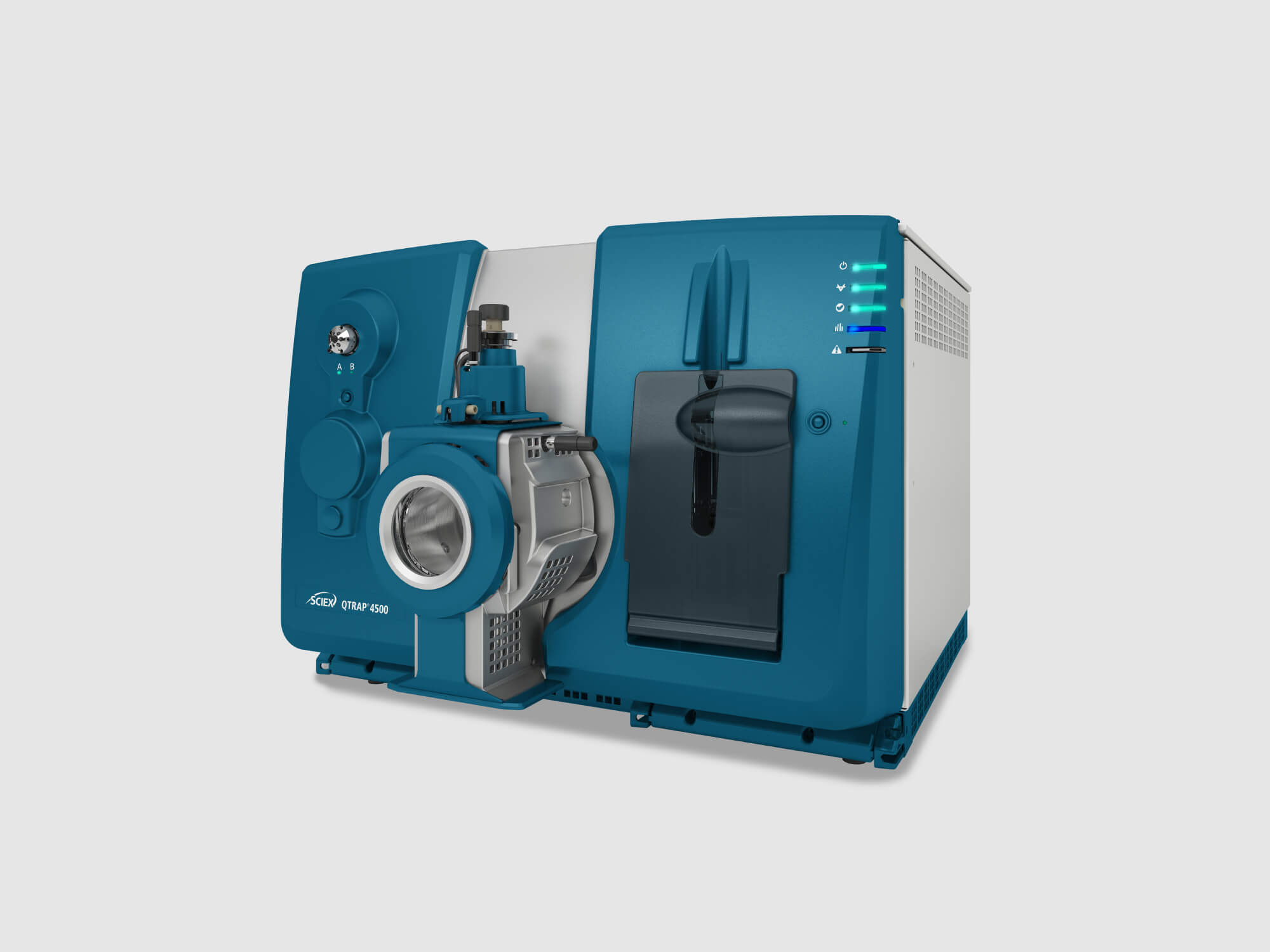
For laboratories requiring ultimate performance, the 4500 Triple Quad system offers consistent, reliable quantitation around the clock. This system is designed to handle high sample volumes and impending deadlines without the data quality erosion that can occur during long runs on less robust platforms.
The 4500’s mass range flexibility, polarity switching capability in just 50 milliseconds, and legendary Turbo V ion source provide high-sensitivity analysis over wide flow rate ranges. The QJet ion guide design yields excellent ion containment and enhanced ion transmission for ultimate sensitivity.
These systems demand more from laboratories, both in terms of initial investment (though used units can represent significant savings) and operator expertise. But for reference laboratories, hospital toxicology departments, and specialty clinics requiring definitive quantitation, LC-MS/MS technology is the gold standard.
Maintenance considerations are real. Vacuum pump upkeep, source cleaning, and calibration requirements mean you should budget approximately 10% of system value annually for proper maintenance. But when your reputation depends on accurate, defensible quantitation, these platforms deliver.
Diatron Pictus 500 and 700: Scalable Chemistry Solutions
For laboratories that need room to grow, the Diatron Pictus family offers intelligent walk-away chemistry with throughput that can scale with your operation.
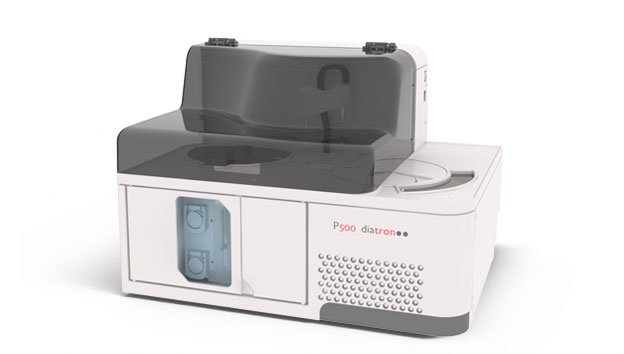
The Pictus 500 is a benchtop system delivering up to 480 tests per hour (combining routine chemistry and ISE). With 72 refrigerated single reagent positions, extensive linearities, and Windows-based software, the P500 provides analytical excellence without overwhelming smaller laboratories.
The system’s internal barcode reader handles samples, sectors, and reagents, reducing manual entry errors. Real-time on-screen inventory management tracks reagent availability continuously. Remote access diagnostics mean many issues can be resolved without waiting for on-site service calls.
Initial capacity of 95 samples (5 racks of 19 samples) with continuous loading up to 99 racks provides capacity for 1,100 samples per day. For most small to medium laboratories, that’s more than enough headroom for growth.
The Pictus 700 takes the platform to the next level. As a floor-standing unit with dual trays and robotic arms, the P700 achieves up to 720 combined tests per hour. With 95 sample positions, 72 single reagent positions, and optional 4-channel ISE, this system can handle daily volumes of 1,800 samples.
Both systems feature low water consumption (1.5-5L per hour depending on usage) and minimal consumable usage, keeping cost per test competitive. Capacitive level sensors and clot detectors ensure reliability. The intuitive Windows-based interface with graphically represented menus and easy-to-use icons means training time stays manageable.
For laboratories anticipating steady growth or those consolidating multiple testing sites, the Pictus family offers a clear upgrade path without abandoning your existing platform investment.
The Reality of Buying Used Equipment
The used equipment market offers compelling cost savings, yet navigating it successfully requires knowledge and caution. That 50% discount on a used analyzer can turn into an expensive mistake if you’re not careful about what you’re buying.
Validation Is Non-Negotiable
Used equipment isn’t “grandfathered” under FDA or CLIA regulations. You must validate every analyzer as if it were new, proving accuracy through proficiency testing per CLSI EP05 guidelines. This typically means linearity studies, precision studies, and comparison to existing methods—work that takes 4-6 weeks minimum.
Skipping validation to get up and running faster is a gamble that can cost you dearly. CLIA suspension, failed inspections, and reimbursement denials all become real risks when you can’t document that your analyzer produces accurate, reliable results.
Service History Tells the Story
Always demand complete service logs before purchasing used equipment. How frequently did the previous owner need repairs? Were there recurring issues with specific components? Was preventive maintenance performed on schedule?
Analyzers with gaps in their service history or frequent repair calls likely suffered from poor maintenance practices or were pushed beyond their designed capacity. You don’t want to inherit those expensive problems.
Reagent Availability Is Critical
Here’s a pitfall that catches many laboratories: they purchase a used analyzer at a great price only to discover the manufacturer has discontinued the reagent system. Now you’re stuck with equipment you can’t use or facing $10,000+ to retrofit it for current reagents.
Before committing to any used analyzer, verify current reagent availability and pricing. Call the manufacturer or authorized distributors directly. A bargain purchase price means nothing if you can’t get the consumables to run tests.
Installation Costs Add Up
Budget for installation costs to exceed quoted prices by 20% or more. Site modifications for power, water, drainage, or ventilation often reveal surprises once work begins. Factor this into your total cost of ownership calculations or you’ll face budget overruns that eliminate the savings from buying used.
Warranty and Service Contract Essentials
New analyzers typically come with 1-2 years warranty. Refurbished units usually offer 90-180 days. That’s your protection window, so extend it with a service contract covering parts and labor.
Service contracts run $2,000-5,000 annually depending on the platform, but they provide insurance against unexpected repair costs that can run $500+ per day in downtime losses alone. When evaluating used equipment, you always factor service contract costs into your total cost of ownership.
Common Mistakes That Cost Laboratories Money
We see laboratories make the same mistakes repeatedly when buying equipment. Here are the most expensive ones to avoid:
Ignoring Equipment History: Buying from unknown sellers without verifying service records means you’re gambling. Always demand documentation and verify it with the manufacturer when possible. OEM certification matters.
Underestimating Calibration Requirements: Inaccurate results lead to reimbursement denials and potential patient harm. Schedule NIST-traceable calibration checks before purchase, not after installation.
Overlooking Seller Reputation: That incredible deal from a seller you’ve never heard of? Probably too good to be true. Verify ISO 13485 compliance, read reviews, and ask for references from other laboratories they’ve served.
Skipping Capacity Assessment: Buying high-end systems for low-volume work wastes money on throughput you’ll never use. Match equipment to 1.5x your projected volume—no more, no less.
Neglecting Service Contracts: The false economy of skipping service contracts catches up fast. One major repair can cost more than years of contract fees, and downtime costs pile up at $500+ per day.
When It’s Time to Sell
Equipment that’s no longer serving your laboratory’s needs still has value—if you approach the sale strategically.
Refurbished analyzers in good condition typically retain 70-80% of new value when properly certified. But that requires documentation. Maintain complete service records, calibration certificates, and validation data throughout your ownership. Buyers want proof the analyzer was well-maintained and produced accurate results.
Timing matters. Selling immediately before upgrading makes sense—it’s equipment you’re no longer using. But trying to sell analyzers that have been sitting idle for months raises red flags for buyers. Keep equipment maintained and operational until sale if possible.
Be realistic about pricing. Research what similar analyzers with comparable age and service history are selling for. Overpriced equipment sits on the market while you continue paying for storage and insurance.
Consider working with established equipment brokers who can handle the sales process, validation documentation, and buyer vetting. Yes, they take a commission, but they also bring expertise and buyer networks that get equipment sold faster.
Laboratory Management Consultants: Your Partner in Equipment Decisions
Making smart equipment decisions requires more than reading specifications and comparing prices. It demands real-world experience with how these analyzers perform in diverse laboratory settings, understanding of the used equipment market, and knowledge of validation requirements that keep you compliant.
Laboratory Management Consultants brings all of that to the table. We don’t just advise on equipment—we actively buy and sell the clinical analyzers that laboratories depend on. That means we understand the market from both sides and can help you navigate these decisions with confidence.
When you work with LMC, you get:
Expert Equipment Assessment: We evaluate your current and projected needs, then match you with analyzers that fit your workflow, space, and budget realities.
Validation Support: We help you navigate the CLIA and FDA validation requirements that ensure your analyzer produces accurate, defensible results. Our templates and protocols streamline the 4–6-week validation process.
Installation Coordination: From site assessment to final qualification, we coordinate with vendors and your facilities team to ensure smooth installation without surprise costs or delays.
Staff Training: Your team learns not just how to operate the analyzer, but how to maintain it properly, troubleshoot common issues, and keep documentation that surveyors expect to see.
Ongoing Technical Support: When questions arise or issues develop, you have experienced laboratory professionals to call, not just an equipment vendor reading from a manual.
Equipment Sales Assistance: When it’s time to upgrade or sell surplus analyzers, we can help you recover maximum value through our equipment sales network.
The Equipment Decisions Your Laboratory Makes Matter
Clinical chemistry analyzers represent significant investments that shape your laboratory’s capabilities for years to come. Whether you’re buying new, purchasing refurbished, or selling equipment you’ve outgrown, making informed decisions separates successful laboratories from those that struggle.
The five platforms we’ve covered—Medica EasyRA, Thermo Fisher Indiko Plus, Abbott ImmTox 270, Sciex LC-MS/MS systems, and Diatron Pictus analyzers—represent proven technology that delivers results across diverse laboratory settings. But success isn’t just about choosing the right analyzer. It’s about validation, installation, training, maintenance, and integration into your workflow.
Laboratory Management Consultants combines deep technical knowledge with active participation in the equipment market. We know these analyzers because we work with them daily. We understand the used equipment market because we navigate it constantly. And we know what it takes to keep laboratories compliant because we’ve guided hundreds through accreditation and inspection processes.
Ready to Make Your Next Equipment Decision?
Whether you’re exploring analyzer purchases, need help with validation, or have surplus equipment to sell, Laboratory Management Consultants can help.
Visit our equipment buying and selling page at https://laboratorymanagementconsultants.org/buying-and-selling-lab-equipment/ to learn more.
Or contact us directly:
Call (606) 487-0523 or email tpace@emaillmc.com to discuss your laboratory’s specific equipment needs.
Don’t make expensive equipment mistakes that cost time, money, and compliance headaches. Partner with consultants who understand both the technology and the business of laboratory equipment. Let LMC help you navigate the clinical analyzer market with confidence.






Medica EasyRA
Thermo Fisher Indiko Plus
Abbott ImmTox 270
The 3200 QTRAP system
The Pictus 500